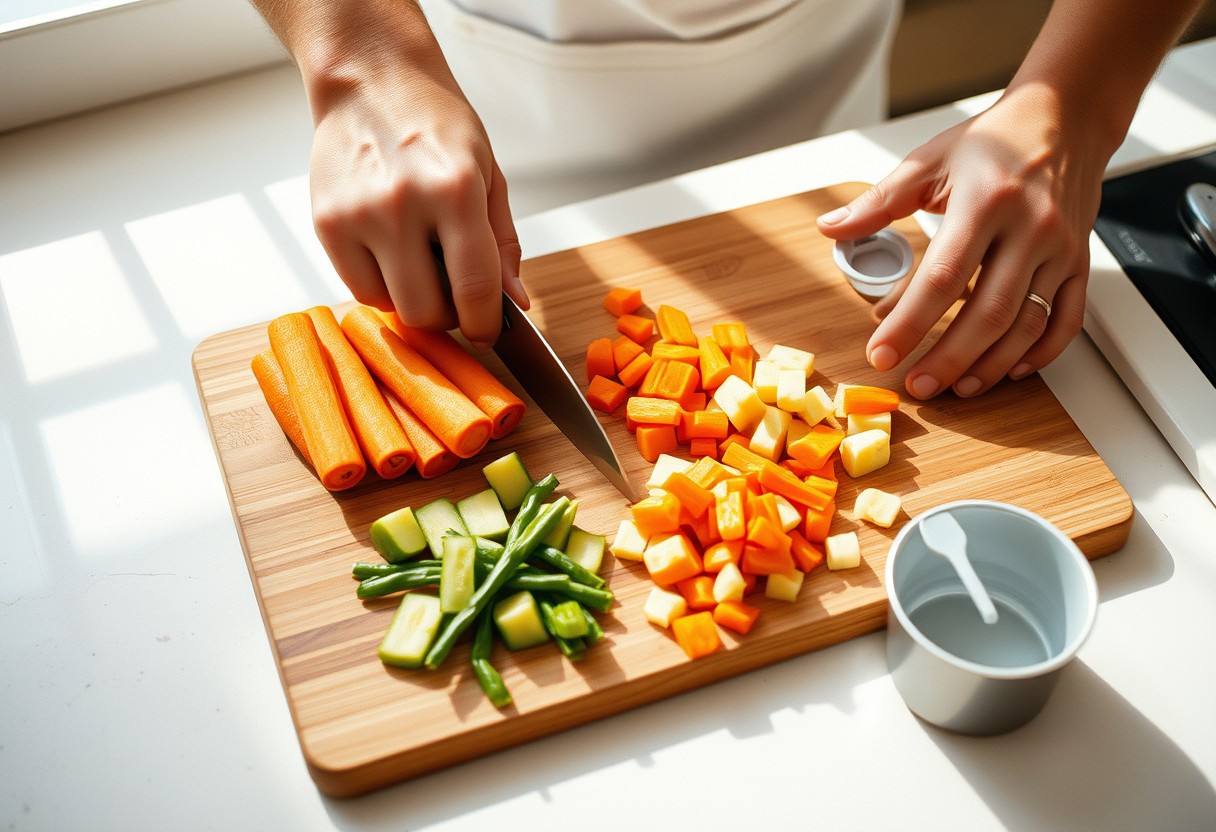
You don’t need years of culinary training to cut food evenly-just a few smart techniques. Uneven pieces lead to uneven cooking, which can ruin even the simplest dish. With the right approach, you can quickly improve your prep work and cook more consistent, better-tasting meals. This guide shows you how to achieve reliable results without stress or precision measuring.
Key Takeaways:
- Cut ingredients into similar shapes and sizes by eye, using familiar objects as visual guides-think matchsticks for julienne, dice the size of bottle caps for onions, or slices as thin as a credit card for cucumbers.
- Let the cooking method guide your cuts: foods that cook quickly, like sautéed greens, can be uneven, while items going into stews or roasts benefit from uniformity to ensure even doneness.
- Use kitchen tools that match your comfort level-a sharp chef’s knife, a rocking herb chopper, or even pre-cut produce-to maintain consistency without needing professional skills or speed.
Assessing the Factors of Food Shape and Texture
Understanding how an ingredient resists your knife begins with observing its internal structure and water content. Dense vegetables like carrots require more pressure to cut than softer ones like zucchini, due to their tightly packed fibers and lower moisture levels. Ingredients with high water content, such as tomatoes or cucumbers, can slip or crush easily under uneven force, making consistent cuts harder. The way a food feels under light pressure-firm, yielding, or brittle-gives you immediate feedback about its structural behavior. Recognizing these differences helps you adjust your hand pressure and slicing rhythm for better uniformity.
- Ingredient density determines how much force is needed to make a clean cut
- Moisture level affects both grip and resistance during slicing
- Firm produce holds shape better; watery items may compress or split unexpectedly
- Texture inconsistencies within a single item (like bell peppers) require real-time adjustments
Evaluating structural integrity for uniform resistance
Different parts of the same vegetable can offer varying resistance based on fiber alignment and thickness. When cutting a celery stalk, the outer strings are tougher than the inner core, leading to uneven slices if not accounted for. You’ll notice that pressing gently with your fingertip reveals which areas feel dense or spongy, guiding where to apply more or less force. Root vegetables with woody centers may need pre-trimming before chopping. Matching cut size becomes possible only after you’ve mapped these internal differences through touch and observation.
Grouping ingredients by similar moisture levels
You’ll achieve more consistent results by organizing items based on how wet or dry they feel before picking up the knife. A ripe mango behaves differently from a raw potato, not because of size but due to its high juice content and soft tissue. Cluster watery foods like tomatoes, citrus segments, or summer squash together, and handle them with lighter, smoother strokes to prevent squashing. Drier ingredients such as onions or sweet potatoes tolerate firmer pressure. This separation prevents accidental crushing and supports predictable cutting patterns across batches.
Essential Equipment Tips for Non-Professional Cooks
Selecting the right tools makes a noticeable difference when you’re not trained in kitchen techniques. A sharp knife is non-negotiable-dull blades slip easily and increase the risk of injury. Choose knives that feel balanced and comfortable in your hand, with a blade length that allows control without overreaching. A reliable peeler and sturdy cutting board also contribute to safer, more consistent results. These manageable tools help compensate for technique gaps while improving overall precision.
- A sharp chef’s knife reduces slipping and improves cut consistency
- Opt for a blade between 6-8 inches for better control
- Use a non-slip cutting surface to prevent shifting during use
- Select a peeler with a comfort grip for safer handling
- Choose tools that feel balanced and lightweight in your hand
Choosing the appropriate blade length for maximum control
A blade that’s too long can be unwieldy if you lack experience or have smaller hands. For most home cooks, a knife with a 6 to 8-inch blade offers enough length to chop efficiently while still allowing precise movements. This size handles a wide range of ingredients-from onions to carrots-without requiring advanced skills. A shorter blade gives you greater command over each cut, reducing mistakes and helping maintain uniformity across your ingredients.
Utilizing non-slip cutting surfaces for safety and precision
Your cutting board plays a bigger role than many realize. A flimsy or smooth-bottomed board shifts with every slice, leading to jagged cuts and potential accidents. Use a board made from stable material like rubber-backed plastic or dense wood, which stays firmly in place. A stationary surface lets you focus on guiding the knife instead of correcting slips. This stability enhances both safety and accuracy, especially when working quickly or with firm produce.
How-to Master the Basic “Rough Chop” Technique
Proper hand placement is your first line of defense against uneven cuts and kitchen mishaps. The bridge grip, where your knuckles rest against the blade while your fingertips curl under, gives you control and keeps fingers safe. Use the claw grip on the ingredient itself-tuck fingertips inward and press the side of the knife against your knuckles as a guide. This alignment ensures each slice matches the last in thickness and shape, even without precision tools.
Establishing a flat base on every ingredient
A stable foundation starts with creating a flat surface on round or irregular items like onions, zucchini, or potatoes. Carefully slice off a small portion of the ingredient to form a solid base that prevents rolling during cutting. This simple step dramatically improves safety and consistency-without it, the item wobbles, leading to jagged cuts and potential slips. Always place the newly cut side down before continuing, so the piece remains steady under the blade.
Executing the rocking motion for consistent thickness
The rocking motion of a chef’s knife is your best tool for maintaining rhythm and uniformity. Keep the tip of the blade in contact with the board and lift only the handle, using a smooth arc to slice through the ingredient. With the claw grip guiding the food and the bridge grip controlling the knife, each pass follows the same path. This technique promotes even cooking and reduces the risk of thin pieces burning while thicker ones remain raw.
Visual Guides and Anchoring Tips for Consistency
Consistency in cut size doesn’t require professional tools-your hands and common household items work just as well. Use the first knuckle of your index finger as a natural gauge for 1-inch pieces, or match cuts to the width of a standard chopstick or pencil for smaller portions. A bottle cap can outline circular slices, while a credit card’s thickness helps judge fine dice. These anchors eliminate guesswork and keep your ingredients cooking at the same rate, especially important when time-sensitive dishes are on the stove.
- Use your knuckle as a built-in ruler for uniform chunks
- Match ingredient thickness to familiar household objects like pencils or bottle caps
- Keep cuts aligned with visual anchors to prevent over-variability
- Rely on consistent physical guides instead of estimating by eye
Using finger joints as a physical measurement gauge
Your hand is always within reach and surprisingly accurate for kitchen estimates. Line up the base of an ingredient with the first crease of your index finger to achieve a reliable 1-inch cut-ideal for stir-fries or roasting. This method beats freehand chopping because it uses a fixed point on your body that doesn’t change. Just keep fingers curled safely inward while using the joint as a stopper for your knife tip, ensuring both uniformity and safety with every slice.
Aligning parallel cuts to create a predictable grid
Start by placing your ingredient flat-side down so it stays stable on the board. Make a series of evenly spaced parallel cuts in one direction, keeping each slice flush against the last. Then rotate the pile 90 degrees and repeat, forming a grid that naturally produces uniform squares. This system reduces randomness and gives you control without needing special skills. The result? Pieces that cook at the same pace and look deliberate and polished, even in a weeknight meal.
How-to Manage Irregularly Shaped Produce
Start by flattening round or tapered vegetables to create a stable base, which prevents slipping and allows for safer, more consistent cuts. Slice a thin portion off one side of the vegetable so it sits flat on the cutting board. Use that flat surface as your anchor while working through the rest. This simple adjustment greatly improves control and reduces the risk of uneven pieces or kitchen accidents, especially with slick or wobbly items like zucchini or eggplant.
Trimming spherical items into manageable blocks
Place a round vegetable like an onion or tomato on its side and slice off the top and bottom to create flat surfaces. Stand it upright on one flat end, then cut vertically around the curve to square off the sides into a rectangular block. Work evenly around the circumference, removing only enough of the rounded edges to form straight faces. This shape holds steady during dicing and ensures each piece cooks at the same rate.
Sectioning tapered roots into equal-volume lengths
Take a tapered root like a carrot or parsnip and cut it crosswise into segments that match the thickest part of the vegetable. If the base is significantly wider than the tip, split the thicker end lengthwise before cross-cutting to balance the volume across all pieces. Keep your knife perpendicular to the board and use consistent spacing so each section exposes a similar surface area for even cooking.
Troubleshooting Factors of Uneven Results
Even with careful cutting, slight variations are normal and manageable. If some pieces cook faster than others, adjust the heat slightly or remove done portions early. Stirring frequently helps redistribute heat evenly. For roasting, flip larger chunks halfway to prevent burning. Uneven doneness isn’t failure-it’s a reminder that real cooking adapts in real time. Stay attentive, not rigid, and trust your eyes over strict timing.
- Watch for visual cues like browning or softness instead of relying solely on timers
- Use a consistent cutting rhythm to improve muscle memory over time
- Group similar-sized pieces together on the pan for more predictable results
Rescuing oversized pieces mid-preparation
You can correct oversized cuts without starting over. If a chunk is too large during cooking, remove it from the pan and slice it in half before returning it. This prevents undercooking while preserving texture in the rest of the dish. Keep a small bowl nearby to hold corrected pieces. Acting quickly ensures the fix doesn’t slow the entire process or compromise flavor development.
Managing the inevitable leftover scraps for secondary use
You’ll often end up with small trimmings when striving for uniformity. Instead of discarding them, reserve scraps in a container for future use. Onion ends, carrot peels, and herb stems add depth to homemade stocks. Even misshapen vegetable bits can become roasted toppings or omelet fillings. Treating scraps as resources reduces waste and boosts flavor in everyday meals. A single extra step now saves time and ingredients later.
Conclusion
You can achieve evenly cut ingredients without formal training by focusing on consistency, using simple tools, and practicing basic techniques. Your knife doesn’t need to be perfect-your attention to uniform size does. Watch how ingredients cook; if they finish at the same time, your cuts are working. For clear visuals and step-by-step instruction, refer to this Knife Skills for Beginners: A Visual Guide to Slicing, Dicing, … to reinforce proper form and build confidence over time.
FAQ
Q: Why does cutting ingredients to roughly the same size matter in home cooking?
A: Uniform pieces cook at the same rate, so a diced potato won’t stay hard while its neighbor burns. When you toss vegetables into a stir-fry or roast them in the oven, pieces of varying sizes lead to some being mushy and others underdone. Even simple tasks like sautéing onions or boiling carrots benefit from consistent cuts because heat affects each piece equally. You don’t need restaurant-level precision-just enough similarity in size to avoid extremes.
Q: I don’t have chef’s knives or a cutting board with measurement guides. Can I still cut evenly?
A: Yes. A basic kitchen knife and any flat surface work fine. Use everyday objects as visual guides: stack coins to estimate 1/2-inch thickness, or compare vegetable chunks to common items-a grape for small dice, a walnut for larger pieces. Align your knife cuts by eye, using the width of your index finger as a rough measure. Focus on repetition; after a few tries, your hand develops a rhythm that improves consistency without special tools.
Q: How do I handle oddly shaped vegetables like zucchini or bell peppers?
A: Cut away irregular edges first to create flat surfaces. For a zucchini, slice off the rounded sides lengthwise to form a stable rectangle before dicing. With bell peppers, remove seeds and membranes, then flatten the sections on the board. Work in stages: halve large pieces, then halve again until the sizes match the rest. Group similar shapes together-flat slices are easier to stack and chop uniformly than wobbly curves.
Q: Should all foods be cut the same way, or does texture change the approach?
A: Texture changes everything. Mushrooms compress easily, so press gently and use a rocking knife motion. Carrots and potatoes resist pressure and need firm, clean cuts. Soft tomatoes require a sharp blade and minimal handling to avoid squishing. Dense foods like sweet potatoes benefit from thinner slices to ensure even cooking, while leafy greens like kale can be torn by hand into bite-sized bits since they wilt down anyway. Match your method to how the food behaves under the knife.
Q: My chopped ingredients still end up uneven. What am I likely missing?
A: The most common issue is rushing through the initial split. If the first cut divides a potato into one thick and one thin half, every piece from those sections will vary. Always aim for symmetry in early cuts. Another mistake is changing knife angles mid-chop-keep the blade perpendicular to the board. Lastly, pile small scraps together before dicing; random tiny bits cook faster and disrupt balance. Set them aside for stocks or sauces instead of mixing them into the main dish.